Japanese Soul Cooking: Ramen, Tonkatsu, Tempura, and More from the Streets and Kitchens of Tokyo and Beyond [A Cookbook]
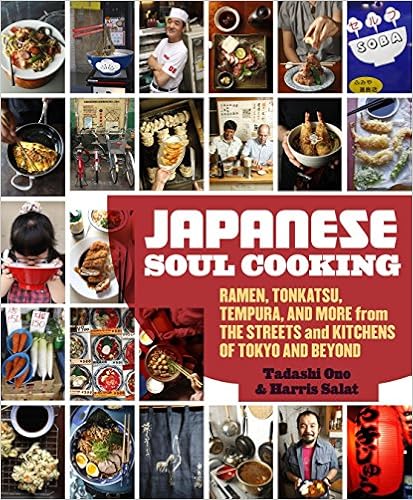
Move over, sushi. It’s time for gyoza, curry, tonkatsu, and furai. These icons of Japanese comfort food cooking are the hearty, flavor-packed, craveable dishes you’ll find in every kitchen and street corner hole-in-the-wall restaurant in Japan.
In Japanese Soul Cooking, Tadashi Ono and Harris Salat introduce you to this irresistible, homey style of cooking. As you explore the range of exciting, satisfying fare, you may recognize some familiar favorites, including ramen, soba, udon, and tempura. Other, lesser known Japanese classics, such as wafu pasta (spaghetti with bold, fragrant toppings like miso meat sauce), tatsuta-age (fried chicken marinated in garlic, ginger, and other Japanese seasonings), and savory omelets with crabmeat and shiitake mushrooms will instantly become standards in your kitchen as well. With foolproof instructions and step-by-step photographs, you’ll soon be knocking out chahan fried rice, mentaiko spaghetti, saikoro steak, and more for friends and family.
Ono and Salat’s fascinating exploration of the surprising origins and global influences behind popular dishes is accompanied by rich location photography that captures the energy and essence of this food in everyday life, bringing beloved Japanese comfort food to Western home cooks for the first time.
Reviews (172)

A Wonderful Resource
I just realized i hadnt written a review for this book. It is a wonderful resource. I always intend to cook more from it -- and i will! -- but the few things I HAVE tried have been divine. It is worth the cost just for the gyoza recipe. (I have made a million dumplings over the eons too). gyoza wrappers are so much more delicate -- and this version has you lightly salt the cabbage and then squeeze out -- SO much easier than precooking -- and so much better a texture than just tossing in raw. I will go in and cook more -- but needed to add my bravo to this great book!!

Authentic Japanese Cooking
This book is a dream find for me! It contains so many of the foods my mother made (she is from Shikoku) when I was growing up! While I make curry, yakisoba, oyako donburi, and the like, this book allows me to make so many of my childhood favorites. Thank you so much to the authors for this enticing trip down memory lane!

Pays itself off with one recipe
This book paid for itself with one recipe! I made the Retro Curry yesterday and it was the best Japanese curry I’ve had since visiting Osaka last year. We’ve eaten Japanese curry many times but it’s usually mediocre and lacking flavor and depth. The curry we had in Osaka was a whole different experience and I have been searching ever since for something comparable but have found nothing outside of Japan. In Japanese restaurants in China and Thailand even we found nothing like it. So you have to understand how excited I was to make my first attempt at a recipe out of this book and find it was something I’ve been searching for for the last year. Now I’m looking forward to trying more recipes. If they are at or even near the quality of the curry, this book will become my favorite cookbook of all time!

A Must Have For Japanese Cooking! Covers the Necessities and Then Some!
The Japanese cook book you've been waiting for! Not only does this book teach you the recipes for the dishes you've been hunting for, but it teaches you how to prepare the necessary bases in japanese cooking! Sauces, broths and other traditional staples in japanese cooking can now be made from scratch in your kitchen! Soy sauce isn't the only ingredient you should keep in your fridge for japanese cooking! Ponzu sauce, okonomiyaki sauce, white miso paste, Mirin, Rice vinigar, Yakitori sauce and Nikiri Sauce are but a few you will know, love and always keep around after learning from this book!

I started cooking with it immediately; great recipes!
I'm really enjoying this book! I've made delicious gyoza with the miso dipping sauce and it was amazing, lettuce with ginger-carrot dressing was amazing, ... the chapters include ramen, gyoza, curry, .... sobe, udon ... I live in a rural area but I used to live on East 9th street in the East Village of NY and at that time it was a center for traditional Japanese food and I really miss it so this book is wonderful in that it is allowing me to enjoy those flavors again!

Simple, doable, and delicious
I moved to Fiji after spending five years in Japan and I sorely missed ramen, kara-age, okonomiyaki, and yoshoku (Japanized western dishes). When I saw this cookbook, I doubted I would be able to make any of them here because of my lack of access to foreign ingredients. A few shops carry Japanese soy sauce (Kikkoman), sake, and mirin, but I couldn't find most of the ingredients listed by the cookbooks I bought in Japan. This wasn't the case with "Japanese Soul Cooking": because it's written for a foreign audience, it makes do with the most basic Japanese ingredients and even teaches how to make some condiments like Tonkatsu sauce from scratch. And because one of the authors is a Japanese chef, the recipes live up to my memory of the comfort food I enjoyed in Tokyo, Osaka, Nagoya, and Hiroshima. And the best part is, they're not complicated at all: I was able to make three recipes from this book in just one week (they were all hits, by the way, especially the Nagoya Tebasaki). I'd recommend this to those who are missing authentic Japanese soul food, no matter where they are (as long as they have access to soy sauce, sake, mirin, miso, and dashi, they're all set). Here's what you can make with this cookbook: Ramen (Shoyu, Miso, and Shio Ramen, among others), Gyoza (includes recipes for homemade rayu & miso dipping sauce), Curry (without the boxed roux!), Tonkatsu (with recipes for panko & tonkatsu sauce, Furai & Korokke (plus how to make Japanese-style tartar sauce and salads), Kara-age (with a recipe for homemade ponzu), Tempura (with step-by-step pictures for making the batter), Okonomiyaki (both Osaka and Hiroshima styles, plus takoyaki and yakisoba), Donburi (nine variations of pure comfort), Soba (hot & cold dishes), Udon (wide range from classics to a modern cold version with fresh tomatoes), Itame & Chahan (stir-fries and fried rice), and Yoshoku (gratins, steaks, and pasta). Highly recommended. Hats off to the authors!

This terrific cookbook captures some of the more popular dishes
I recently read that over 100,000 Japanese restaurants now exist . . . outside of Japan. This terrific cookbook captures some of the more popular dishes, and they are indeed comfort/soul food. We have a generous library of cookbooks, and this is one of my favorites. Great recipes, ample photos, and one of the best recipes I've ever tried for one of the top "soul food" dishes popular in Japan itself, curry, only this one has a special "Battleship Curry" included. Nothing super esoteric or overly fancy here, no Kaiseki, just darn good recipes which you'll enjoy making over and over again!

A bit difficult to follow
I bought this book mostly because I want to learn how to make traditional ramen, you know, the good stuff. I found the concept of making ramen daunting and complex. This book didn't really help much. I think I assumed this book was geared toward non-Japanese people who wanted to make Japanese food at home, but I think it assumes you have some basic knowledge of terminology or ingredients. Some ingredients are explained in the index, but others are not. Perhaps they didn't have enough overseas beta readers to point out things that need explaining. It seems like the people who enjoy it most are people who used to live in Japan for extended periods of time from what I can tell in other reviews. In most recipes it references another recipe, so each recipe isn't really complete because you have to reference multiple recipes for ingredients and instructions. Even though it would be redundant, I kinda wish the base recipes were in each of the recipes that use it (if that makes sense). Flipping back and forth between recipes, making sure you have all the ingredients, and trying to figure out timing when they are separated can feel quite overwhelming. I didn't expect making ramen to be simple, but this book didn't really help me to understand it any better. I'll probably end up making Joshua Weissman's tonkotsu ramen or Asian at Home's shoyu ramen.

barely OK
I think the book is a great addition to understanding accessible Japanese food - including an interesting historical perspective. That said, I also believe it does a disservice to the broader spectrum of foods from Japan - by starting with "Let's start with a groundbreaking moment back in 1892, when Emperor Meiji of Japan did something no other ruler of that country had done for a thousand years, namely, bite into a juicy hunk of meat in public.". With this intro, you know the book is doomed to be dominated by mostly contemporary hybrids of dishes: heavily relying on chicken, pork and beef - not he most traditional or even the dominant trend; incredibly lacking on seafood and vegetarian dishes - both major components of food elements in Japan - yesterday, today and tomorrow.

Great for the home cook and not loaded with complex ...
This book is superb. Great for the home cook and not loaded with complex time consuming processes. I have the Simply Ramen book which is nice, but the raman soup base recipes are a bit laborious. I have made them and have the time to do so, but think the Soul Food approach is about as good. I am not a sushi fan so this book is great as it covers street food which I prefer.


Comments
Post a Comment